
Men, please do this one thing

Welcome to One Day Better, where I share small steps to make today a little better than yesterday.
This week, I’m writing about:
The Men’s Health Paradox
Joyscrolling!
A message for men and the people who love them
As June comes to a close, we’re ending Men’s Health Month with news that Representative Thomas H. Kean, Jr., the New Jersey Republican who disappeared from Congress for weeks, revealed he had been hospitalized to treat depression.
It’s a brave admission for anyone, and he is among the minority of men to seek care for mental health. In one survey, two out of three men said they are hesitant to seek medical help for depression, stress and anxiety. Women are twice as likely as men to seek mental health care.
Kean’s story reflects a broader pattern that extends far beyond mental health. The reality is that most men suffer in silence when it comes to both mental and physical health.
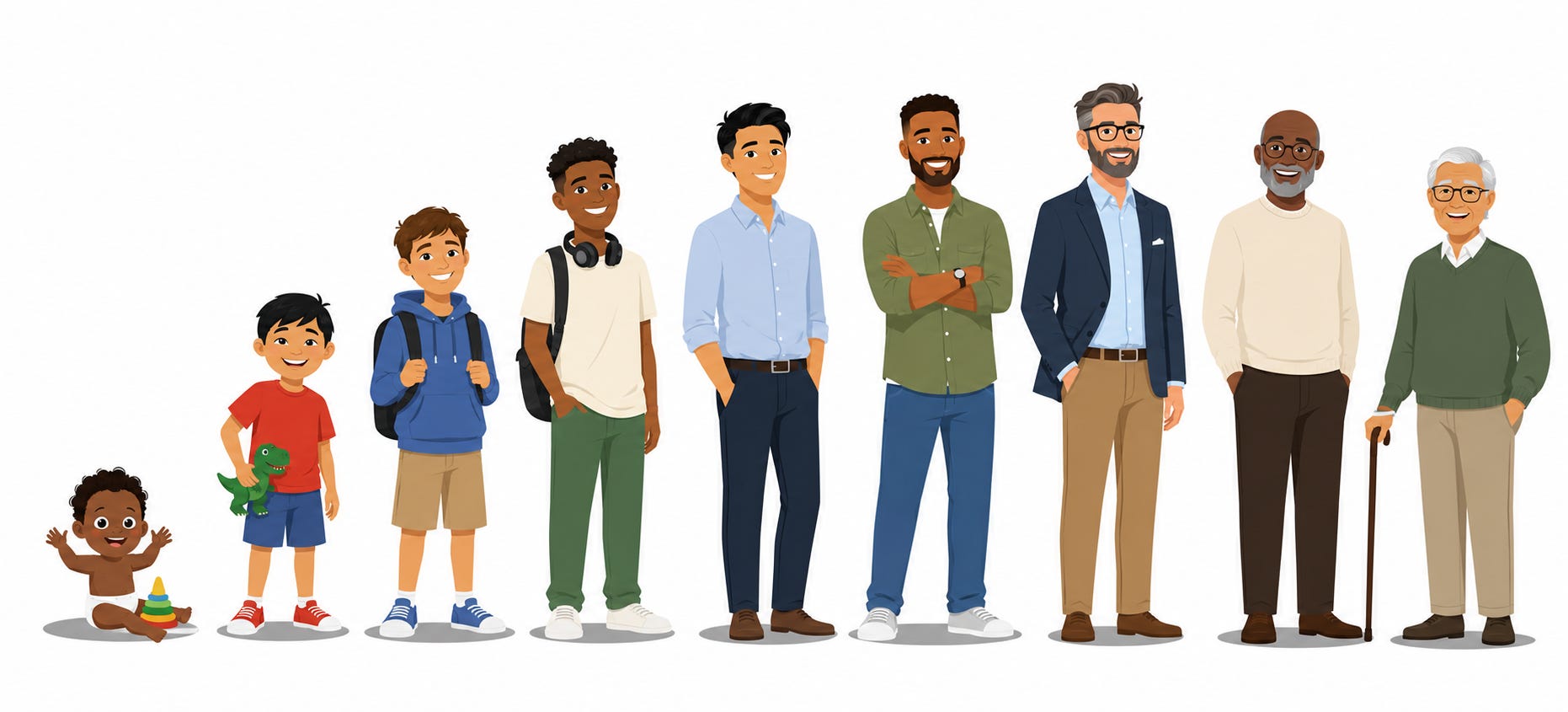
Here’s my wish for the men in our lives, all the fathers, grandfathers, husbands, partners, uncles, brothers, sons and nephews: Schedule the doctor’s appointment you’ve been putting off.
For years I’ve written about what researchers call the men’s health paradox. On paper, men appear to have a lot going for them. They have historically been the primary focus (and beneficiaries) of medical research and drug development. Compared to women, men are more likely to rate their health as good or excellent and less likely to report symptoms or illness. And let’s state the obvious: Men don’t experience the reproductive health challenges that affect women, including pregnancy, childbirth, and menopause.
And yet, despite these apparent advantages, men experience higher rates of premature death from many of the leading causes of mortality. Across the lifespan, boys and men are more likely to die at every age than girls and women. From Covid to cancer, suicide to car accidents, being male is a risk factor for a poorer outcome. The gap begins in utero and infancy, and persists through adolescence, young adulthood, midlife, and old age.
The result is a longevity gap between men and women. According to the latest CDC data, life expectancy in the United States was 81.4 years for women and 76.5 years for men in 2024, a difference of 4.9 years
Biology explains some of the gap. For instance testosterone weakens the immune response, making men more vulnerable to dying from infection. Men tend to engage in more risky behaviors, including reckless driving and substance abuse.
But culture plays a powerful role too. Men tend to wait longer to seek care and diseases such as heart disease, diabetes and high blood pressure are often more advanced by the time a man is diagnosed. Women are far more likely than men to see a doctor for preventive care and routine checkups. In a national CDC analysis, women had 76.6 preventive care visits per 100 people, compared with 45.4 per 100 men, a 69% higher rate.
Women often complain about male partners who refuse to go to the doctor. One woman I interviewed asked her pediatrician for diabetes test strips because her husband refused to seek care. She slipped the test strips into her husband’s briefcase with a note begging him to self-test during a business trip. Sure enough, the results suggested diabetes, and he finally agreed to see a doctor.
A physician told me about a patient whose wife begged, pleaded and even refused to have sex with her husband unless he saw a doctor. Nothing worked. Finally, he acquiesced when she refused to sign their joint tax return unless he sought care.
Men are less likely than women to have a primary care physician and more likely to seek health care only on an as-needed basis, often when symptoms have progressed. Men tend to be reactive, vs. pro-active users of the health care system, often seeing a doctor for sports injuries or because of erectile dysfunction. In fact, doctors say they often use the “Viagra visit.” to do full workups on their reluctant male patients. And it can be especially informative because erectile dysfunction can be an early warning of heart disease.
The solution to the men’s health paradox is not a mystery. We know many of the reasons men die younger, and we know the steps that can help them live longer. Many of the biggest threats to men’s health, including high blood pressure, diabetes, high cholesterol, colon cancer, skin cancer, depression, and heart disease, can be prevented, treated, and managed when caught early. The challenge is getting men to act.
And here’s the reality: it’s not just about men. When men die prematurely, the women and children in their lives suffer. Widows are far more likely to live in poverty than other groups. When men live longer, healthier lives, the women and children in their orbit also benefit.
So consider giving the men in your life a simple reminder: We want you here. We want you healthy. We want you around to celebrate many more Father’s Days, Men’s Health Months and 4ths of July. Please, schedule that check up.
Joy scroll with me!
Here’s my weekly roundup of good news and interesting links to counteract the gloom.
Meet the world’s most-traveled rescue pup. His name is Elko. View on Instagram.
My scary foster’s bath routine. You have to see this canine bath and beauty routine to believe it. Plus it’s excellent dog ASMR. If you’re not sure what that is, read this excellent WaPo story (gift link) to find out. But first watch the best dog bath ever.
Farmer cuddles. It’s a video of a farmer cuddling cows, goats, bunnies, turkey. It’s endearing.
Adrien Brody walks to work. In a popular video, the actor Adrien Body is just a nice friendly person, and it’s striking a chord with his fans. Watch on Instagram.
See the milky way. You can get lost in the photos captured by New Zealand photographer Connor Paton. This time-lapsed video is no exception. Watch on Instagram.
Dancing robots. This blew my mind. I’m still not sure how I feel about it! Watch on YouTube.
Are flash mobs still a thing? Here’s a fun dance flash mob with only humans, no robots. Enjoy.
Every week, the One Day Better newsletter celebrates the power of small steps. If you enjoyed reading, please share it with a friend. This newsletter is free and reader-supported. If you’d like to support my work, you can make a contribution here.
Tara Parker-Pope, MPH is an Emmy Award–winning journalist who shared in the Pulitzer Prize for Public Service for New York Time’s coverage of the pandemic. She has an MPH from the Yale School of Public Health. Learn more at taraparkerpope.com.
Yes, let's talk more about men, boys including adolescent and baby boys. Let's also focus on some of the very worst off men and boys in the world. Whom I've worked with, tutored, counselled.
I'm talking about the Mainland Aboriginal men and boys of the Wet Tropics of Far North Queensland. Who are worse off than Torres Strait Islander men. Who are worse off than Irish Roman Catholic poor white men. Who are worse off than Anglo Protestant upper working-class white Australian men. Who are worse off than middle-class white Australian men. Who are worse off than the land-owning upper-class white Aussie males of English heritage, the squattocracy.
Socioeconomic class and culture, including religion, determine our years, levels, and qualities of formal schooling. Later, that determines our paid occupations, which determine our income and social status.
Occupation, income and social status, culture including religion, intelligence as measured by IQ, our environment at work and home, plus our genetics and epigenetic environment in our mother's womb, plus our choices, plus access to medical resources, plus luck of the draw, determine how sick or well we are.
The sickness stats for aboriginal men and boys in Australia and in North America are mind boggling. For example, at one time the suicide rates amongst young men and adolescent boys in the White Mountain Apaches were the highest in the world, at more than 100 per 100,000.
More context. In highly homogenous, regulated societies like Japan, the homicide rate is less than one per one hundred thousand.
As a mathematical physicist who tries to model the real world and the entire universe from the very big to the very small, I'm driven by the data. Follow the numbers.
As a humanist, ethicist, and poet who seeks to model humanity and all our works, good and evil, I'm driven by pity. Follow the suffering.
The Aboriginal men and adolescent boys I tried to teach, tutor, mentor, coach, counsel, advise, aid, had bad experiences and bad outcomes.
They ended up in prison for murder. They killed others. They were killed by others. They became alcoholics, developed aggressive T2DM in their thirties, were on dialysis by forty, losing their legs to peripheral neuropathy and gangrene by forty-five, dead by fifty, leaving behind widows and orphans.
Yet, when Captain James Cook visited the Tiwi Islanders in HMS Endeavour in 1770, he wrote in his ship's journal that he had never seen such impressive examples of human beings, long legged, lean as sticks, wiry, strong, swift, skilled, staminal, spiritual.
What went wrong?
What went wrong is that these impressive, fearless, proud warriors had their custodianship of Country of sixty thousand years stripped from them by avaricious and venal white men.
They descended into despair.
They were introduced to alcohol by the Irish convicts, the tickets-of-leave men. Their adolescent girls were raped and impregnated by the same white men. The half caste children were rejected by the tribes of their black mothers and by the tribes of their white fathers.
Today, Australian aborigines aka black fellas are Irishmen in black skins, alcoholics swimming before birth in the alcohol of their mothers' wombs.
The Irish and the Cornish, who make up my heritage, were traumatised by Anglo Norman white men.
Thus trauma is intergenerational: passed on from generation to generation forever. It never ends. The sins of the fathers shall be visited on their children and on their children's children.